PET polymer selection guide for packaging, film, fiber and engineering uses

What PET polymer is and where it fits
PET polymer, or polyethylene terephthalate, is a thermoplastic polyester used in bottles, trays, films, fibers, strapping and selected engineering parts. It is specified when a design needs a practical mix of clarity, stiffness, toughness, dimensional stability and gas-barrier performance. In packaging, PET can offer a clearer and stiffer alternative to polyolefins such as PP or HDPE. In engineering applications, especially when reinforced, it can provide useful stiffness and wear performance, but it requires tighter control of drying, crystallization and processing than simpler commodity resins.
The selection question is not whether PET is a good plastic in general. It is whether the application needs PET’s combination of barrier, appearance, strength and recycling compatibility enough to accept its limits in heat exposure, hydrolysis sensitivity and alkaline environments.

For broader material comparisons, see the Polymer Selection category.
Key properties that drive PET selection
PET is commonly described as a semi-crystalline polyester, but commercial PET products may be mostly amorphous and transparent or more crystalline and opaque. The final structure depends on cooling rate, orientation, additives and heat treatment. This structure-sensitive behavior is why PET can appear as a clear beverage bottle, a biaxially oriented film, a textile fiber or a rigid molded compound.
| Selection factor | Typical PET behavior | Why it matters |
|---|---|---|
| Thermal behavior | Glass transition is often around 70-80°C; crystalline melting peak is commonly around 245-255°C, depending on grade and test method. | The melting point looks high, but stiffness can decline near the glass transition unless the part is oriented, crystallized or reinforced. |
| Clarity | Amorphous PET can be highly transparent; crystallized PET becomes hazy or opaque. | Excellent for clear packaging, but thermal history must be controlled. |
| Barrier | Better oxygen and carbon dioxide barrier than many commodity polyolefins. | Useful for carbonated beverages, food trays and aroma-sensitive packaging. |
| Mechanical performance | Good stiffness, tensile strength and toughness, especially when oriented. | Supports thin-wall packaging, strapping, films and fibers. |
| Processing sensitivity | Moisture must be controlled before melt processing. | Hydrolysis can reduce molecular weight and damage mechanical performance. |
Thermal behavior and crystallinity
A common selection mistake is to compare PET’s melting point directly with service temperature. PET does not suddenly fail at its glass transition, but unreinforced amorphous PET can lose stiffness as temperature rises into that range. Crystallized PET, oriented PET film and glass-reinforced PET compounds behave differently because molecular orientation, crystal content and fillers restrict chain mobility. For hot-fill packaging, appliance parts or electrical components, grade choice and part design matter as much as the polymer name.
Barrier, clarity and mechanical performance
PET is strong in applications that need a clear, glossy surface with better gas barrier than PE or PP. Beverage bottles use orientation to improve strength and barrier performance while keeping weight low. Films use biaxial orientation for tensile strength, dimensional stability and optical quality. Fibers use PET’s polyester backbone for strength, abrasion resistance and durability. In each format, performance comes from both the polymer chemistry and the processing route.
Chemical resistance and moisture sensitivity
PET has useful resistance to many oils, alcohols and dilute acids, but it is not a universal chemical container resin. Strong alkalis can attack the ester linkage, and high-temperature moisture exposure can promote hydrolysis. During melt processing, resin drying is especially important because wet PET can suffer chain scission, lower intrinsic viscosity and reduced toughness. This is one reason PET processing normally requires tighter preparation than PP or HDPE.
When PET is a strong choice
PET is often a strong candidate when the design needs several of the following requirements at the same time:
- Clear rigid packaging: bottles, jars, trays and thermoformed packaging where transparency, gloss and toughness are important.
- Carbonated or oxygen-sensitive packaging: containers that need better gas barrier than many polyolefins can provide.
- Thin films: oriented PET film is used where tensile strength, printability, dimensional stability and clarity are valued.
- Fibers and textiles: polyester fiber is one of PET’s largest application areas, with broad use in apparel, industrial yarns and nonwovens.
- Strapping: PET strapping can offer high tensile strength and better retained tension than some lower-performance alternatives.
- Engineering compounds: glass-filled PET can be considered for rigid components that need dimensional stability, stiffness and electrical insulation.
In packaging, PET’s main advantage is the combination of clarity, strength and an established bottle recycling infrastructure. In industrial parts, the advantage is narrower but still important: reinforced PET can be dimensionally stable and stiff when processing and crystallization are well controlled.
Where PET needs caution
PET should be reviewed carefully when an application involves high continuous heat, boiling-water exposure, strong alkaline cleaners, repeated flexing, live hinges or poorly controlled molding conditions. The polymer can perform well in demanding settings, but the grade and process must match the environment.
- Heat exposure: A high melting point does not mean an amorphous PET part will remain stiff at elevated service temperatures. Heat-set, crystallized or reinforced grades may be needed.
- Moisture during processing: PET should be dried properly before extrusion, injection molding or sheet production. Poor drying can reduce molecular weight and cause brittleness.
- Alkaline attack: Strong bases and aggressive cleaning agents can degrade PET more readily than they degrade many polyolefins.
- Impact at low temperature: Impact performance varies by grade, orientation and part geometry. If drop impact is critical, finished-part testing is more reliable than resin-family assumptions.
- Recycling contamination: PET’s recycling value depends on stream quality. Colorants, incompatible labels, barrier layers, PVC contamination or non-PET components can reduce recyclability.
These cautions do not rule out PET. They define the engineering checks needed before it is specified.
PET vs common alternatives
Material selection is usually clearer when PET is compared with the resin most likely to replace it. The table below summarizes typical decision trade-offs.
| Material comparison | Where PET is usually stronger | Where the alternative may be stronger |
|---|---|---|
| PET vs PP | PET usually offers better clarity, stiffness and gas barrier. | PP is lower density, often better for living hinges and may resist some chemicals better. |
| PET vs HDPE | PET is clearer, stiffer and better for carbonated beverage barrier. | HDPE has excellent moisture resistance, toughness and chemical resistance for many containers. |
| PET vs PVC | PET avoids chlorine content and is widely used in food and beverage packaging. | PVC can be easier to process for certain profiles, films and medical applications, subject to formulation and regulatory needs. |
| PET vs PETG | PET generally offers better crystallinity-based heat options and a more established bottle stream. | PETG is easier to thermoform, more amorphous and often more forgiving for clear sheet fabrication. |
| PET vs PBT | PET can be attractive in fibers, films, packaging and cost-sensitive reinforced applications. | PBT crystallizes faster and is often preferred for injection-molded electrical and automotive parts. |
For packaging, PET competes mainly with PP, HDPE, PVC and PETG. For molded engineering parts, it is more often compared with PBT, nylon, acetal and reinforced PP. The right comparison set depends on the part’s function, not only on resin price. See also: Buying Guides.
Recycled PET and food-contact considerations
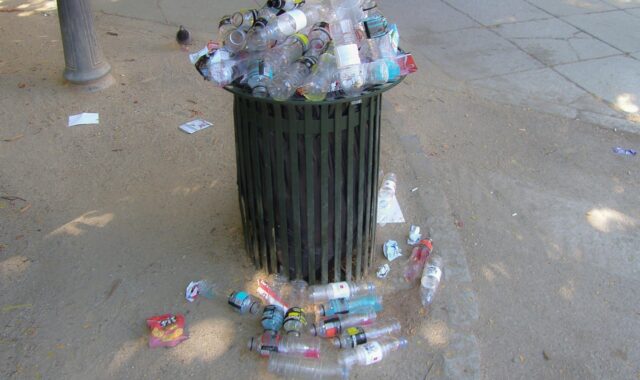
PET is one of the more developed plastics in mechanical recycling, especially in bottle applications. In the United States, ASTM D7611 identifies PET or PETE as resin identification code 1. The standard is used for resin identification; the code by itself does not prove that a package is recyclable in every local system. Collection access, package design and end-market demand all affect the actual recycling outcome.
Industry data also shows why design-for-recycling matters. NAPCOR’s 2024 PET Recycling Report, released in December 2025, reported a U.S. PET bottle collection rate of 30.2% for 2024, down from 32.5% in 2023. That figure does not mean PET lacks recycling value. It means the bottle stream is established but still limited by collection, sorting, yield and demand conditions.
Food-contact recycled PET requires additional scrutiny. FDA guidance for recycled plastics in food packaging focuses on chemistry considerations, contaminant removal and the intended conditions of use. In the European Union, Regulation (EU) 2022/1616 has applied since October 10, 2022 and sets a framework for recycled plastics intended for food contact. EFSA also updated scientific guidance in 2024 for evaluating post-consumer mechanical PET recycling processes used for food-contact materials. For buyers, the practical point is straightforward: do not specify rPET for food contact based only on recycled content targets. Confirm process authorization, feedstock controls, decontamination validation and market-specific compliance.
Practical PET polymer selection checklist
Before specifying PET, a buyer or designer should convert the application into measurable requirements. The checklist below helps prevent a broad resin-family choice from becoming a processing or compliance problem.
- Define the product format: bottle, tray, film, fiber, sheet, strapping or molded part.
- Set optical requirements: clear, tinted, opaque, crystallized, glossy or printable.
- Confirm service temperature: include filling temperature, sterilization, warehouse heat, transport and consumer use.
- Map chemical exposure: product ingredients, cleaning agents, oils, acids, alkalis and humidity.
- Check mechanical loads: drop impact, creep, tensile load, burst pressure, flexing and dimensional tolerance.
- Specify processing route: injection molding, blow molding, extrusion, thermoforming, film orientation or fiber spinning.
- Control moisture: require drying conditions and moisture limits appropriate for the selected grade and process.
- Plan recycling compatibility: review color, labels, adhesives, closures, additives and multilayer structures.
- Verify compliance: food contact, recycled content, regional rules and customer specifications must be checked against the exact grade and supplier documentation.
This checklist also helps identify cases where PET is not the most efficient choice. If the application needs a living hinge, very high alkaline resistance, the lowest possible density or simple low-cost molding with minimal drying, another resin may be better suited.
Frequently asked questions
Is PET polymer the same as polyester?
In many industrial and consumer contexts, polyester fiber refers to PET. The word polyester describes a broader chemical family, while PET is a specific polyethylene terephthalate polymer within that family.
Is PET always transparent?
No. Amorphous PET can be very clear, but crystallized PET becomes hazy or opaque. Processing conditions, orientation, nucleating agents, fillers and heat treatment all affect appearance.
Is PET suitable for hot-fill packaging?
PET can be used in hot-fill applications when the bottle or container is designed and processed for that purpose, often through heat-setting and crystallinity control. Standard amorphous PET packaging should not be assumed suitable for high-temperature filling without validation.
Can recycled PET be used in food packaging?
Yes, but only when the recycling process, feedstock, decontamination performance and intended use meet the relevant regulatory requirements. FDA guidance, EU Regulation 2022/1616 and EFSA evaluations show that food-contact rPET is a process-specific compliance question, not just a material label.
When should a designer choose PETG instead of PET?
PETG may be a better choice for clear thermoformed sheet, displays or fabricated parts where easy forming and amorphous clarity are more important than crystallinity, higher heat options or compatibility with a PET bottle recycling stream. PET is usually preferred when orientation, bottle performance, fiber use or established PET recycling pathways are central to the design.